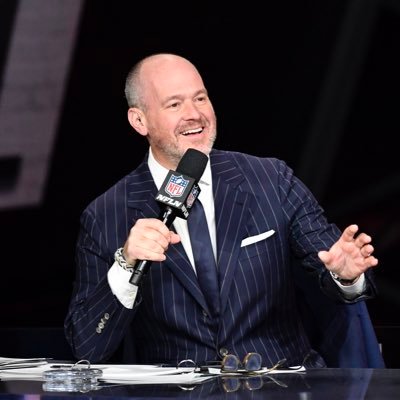
Booked in February, confirmed in July, and the only travel Nick Mansour has done in a camp week.
He came in with one person from the Browns, who sat off camera and did not speak, and he stayed
through the end of the show rather than the end of his hour. What follows is most of Hour 2 and
the back half of Hour 3, cut for length and for eleven minutes about a restaurant in Culver City.
Hour 1 · 12:44 p.m. ETBefore he comes out
EISEN: — and we are eleven minutes from something I have been asking for since the last week of January, which is that the head coach and general manager of the Cleveland Browns is in this building. He is in the green room. He has been in the green room since a quarter past twelve because he showed up early, which nobody does, and Brockman has an issue with it.
BROCKMAN: I don’t have an issue. I have a question. What is he doing here in the first week of August?
EISEN: He’s promoting nothing! There’s no book, there’s no movie, there’s no charity 5K. A man with three quarterbacks and no starter got on a plane on a Wednesday night in August to come sit in that chair, and I find that fascinating.
DEL TUFO: He flew commercial. Somebody in Cleveland sent us a picture of it.
JEFFERSON: There’s a photo of him in a middle seat and it did better on our page than any football we’ve posted this week.
BROCKMAN: Because it’s a middle seat, Rich. Nobody has ever seen a head coach in a middle seat.
EISEN: All right. Here’s what I want to do in this hour, and I want to say it before he walks out here, because once he’s sitting down I’m going to be nice to him. Everybody has asked this man about his age. Everybody has asked him about the money. I would like to ask him about a trombone.
NM
Nick MansourHead Coach & General Manager, Cleveland Browns · in studio, Hours 2 and 3
Nick MansourHead Coach & General Manager, Cleveland Browns
Hour 2 · 1:02 p.m. ETThe ninety pages
EISEN: Nick Mansour is here, in a suit, in Los Angeles, in a camp week. I want to start where nobody starts, which is January the twelfth, because I have read four accounts of that day and they don’t agree with each other. You went in to be a scout. Do I have that right? You went in to be a scout.
MANSOUR: They asked me in to talk about the department. How it was organized, what the boards looked like, where they thought they were thin. I prepared for that, and then I kept going, which is a thing I do. I had about ninety pages of things nobody had asked me about. My sister told me not to bring all of it. I brought all of it.
EISEN: Ninety pages. For an entry-level personnel job. Was there a point in that room where somebody put a hand up and said, sir, we asked you a much smaller question?
MANSOUR: Roger Greyson took the whole thing home. He read it. He had notes on page sixty-one.
BROCKMAN: Hold on. Do you know what page sixty-one is off the top of your head?
MANSOUR: Special teams. I had a section about how nobody staffs it like it’s a third of the game, and I was rude about it in writing, and he agreed with me, which was the first thing that made me nervous.
EISEN: Okay, so walk me through this, because your entire coaching résumé fits inside this sentence I’m about to say. (pause) That was the sentence. There isn’t one. I’ve been doing this a long time and I have never once sat across from a head coach where the sentence is empty.
MANSOUR: I haven’t done this. (pause) Sorry, I know that isn’t much for you to work with. It’s the accurate one, and I’d rather not put something next to it that I made up on the plane.
DEL TUFO: Shortest answer we’ve gotten all year.
EISEN: Do you get asked that every day at home, or has Cleveland moved on to newer complaints about you?
MANSOUR: Every day. Mostly the same four guys, and they’re decent about it.
Hour 2 · 1:19 p.m. ETThree quarterbacks, one defensive line
EISEN: Shedeur Sanders, Dillon Gabriel, Taylen Green. It is the sixth of August, you have not named one, and there are people in your own market who’ve decided that means something has gone wrong in there. Has something gone wrong in there?
MANSOUR: No. And I’d rather give you the real version than say “competition,” which mostly means a coach hasn’t decided yet. I haven’t decided, because I haven’t decided what we’re running. Those three play different sports. Dillon gets us to the line in a hurry and lets me live in tempo, and tempo is worth more to us than it is to most teams because our install is one language instead of twelve, so we can go fast without getting dumber. Shedeur will stand in there and hold a throw two counts past when it’s comfortable, and that opens up a whole shelf of stuff down the field I can’t call for anybody else. Taylen makes people wrong with his legs and I have not built enough that uses it, which is on me, because I’ve had him since April. So it isn’t a ranking. It’s which offense I want to be in November against a division that’s seen us twice by then. That’s my call and I’ve been slow with it. I’ll name somebody before Jacksonville, and not because there’s a custom about naming one, but because he needs the reps with the ones and the other two need to know so they can get on with their week.
BROCKMAN: You just told the country you’ve had a rookie quarterback since April and haven’t built for him.
MANSOUR: Coaches don’t say it out loud. Everybody has a list of what they haven’t gotten to. Mine’s on the wall in my office, it has forty-one things on it, and I’ll finish maybe thirty by September.
EISEN: Let’s do the defensive line, because Myles Garrett is a Ram, Maliek Collins is on PUP, Jared Verse came back in that trade, and half the analysts I trust — people I have on this show, people I like — think that front is the reason you lose eleven games this year.
MANSOUR: They’re looking at the right thing. I’ll go further than they will, because it’s mine. I built that front light on purpose. Everything about the interior is designed to get up the field and make a running back move his feet before he wants to, and it’s a good bet when you’ve got Collins healthy behind it and it’s a much worse bet when you don’t. I made that bet in March with the health information I had, and I didn’t build a second version. So right now, on early downs, against a team that just wants to run gap schemes at us, I’m asking a front to do the one job I deliberately didn’t build it for. The answer is not a speech to them, it’s that I’m taking early-down snaps off Jared so he’s got legs on third down, and Mike Rutenberg and I have Carson Schwesinger fitting more of it than a second-year linebacker should have to, and Carson has been outstanding about it. What that costs is first down. We’re going to be worse on first down this year on purpose, and I’d rather tell you that in August than have you find it out in Jacksonville and think I didn’t know.
JEFFERSON: Coaches sit right there and tell me the room is hungry. You just told me which down you’ll be bad on.
MANSOUR: If I say it now it’s information. If I wait and say it in October, everybody hears an excuse, and honestly they’d be right to, so I’d rather have it out here in August where it’s no use to me.
BROCKMAN: Does anybody in your building ask you to stop doing that? Saying the quiet part in August?
MANSOUR: Our communications director does. Every week.
EISEN: One question about the money and then I’m leaving it. A hundred and seventeen point six million dollars in dead cap, on one season, for a man who is not on your roster. When you sit down to build a defensive line, does that number sit in the room with you?
MANSOUR: It was my recommendation and the family didn’t hesitate. It’s a real number and it cost us a player somewhere else this year, probably an interior defensive lineman in the eight-to-ten-million range, which is exactly the guy I’m telling you I don’t have. I’m not going to pretend the football part of it was free.
EISEN: All right. I said one and that was one.
Hour 2 · 1:41 p.m. ETMichigan State, 2016 to 2019
EISEN: So here’s the thing I flew you out here for. Four autumns in the Spartan Marching Band. Trombone on the field, bass guitar with the basketball band, which means you were on the floor in Minneapolis for a Final Four. You were inside the biggest rooms in college sports for four years and you were nowhere near the program. That’s Almost Famous. That’s a kid on the bus who isn’t in the band, except you were in the band.
MANSOUR: That’s about right, and I’d push back on one word, which is “inside.” We were in the tunnel a lot. You’re in the tunnel forty-five minutes before kickoff standing in a line of a hundred and thirty people holding brass, and there’s a rope, and on the other side of the rope there are men in headsets doing a job, and nobody on either side of that rope is thinking about the other one. It’s not a sad thing. Everybody’s working. We had a call time and a drill chart and a bus, and the bus left at the time on the sheet whether you were on it or not. I was good at it. Good ear, I picked up drill fast, but there were people in that band who were going to teach music for forty years and I was not one of them and we all knew which was which by about October of freshman year.
BROCKMAN: Were you any good, though? Like objectively good, not band-kid good.
MANSOUR: Third chair. Which is a real answer and not a modest one. There were two people better than me and about twenty who weren’t, and the twenty knew it too.
DEL TUFO: He knows exactly where he ranked in a band.
EISEN: Do you still have the horn, or is it in a closet at your parents’ house?
MANSOUR: It’s at my parents’. My dad keeps it out on the piano.
DEL TUFO: On top of the piano. That’s a proud man.
EISEN: Here’s my question and I want the real answer, not the polite one. Four years of standing thirty feet from the thing you cared about more than anything in the world, on the wrong side of a rope. Did you want in? Were you standing there wanting in?
MANSOUR: (long pause) No. And that’s a stranger answer than wanting in would be, so let me try to say it right. It never once occurred to me that it was a job. I knew a lot of football by then, I was arguing about it constantly with anybody who’d let me, and I understood in some way that grown men were paid to do the thing on the other side of the rope, but I never connected it to me. Not once in four years. Which I think about more now than I think about the band, and I don’t have a good explanation for that either.
JEFFERSON: Can I ask about the other thing, then? Twenty-four years old, you apply to a scouting service. What was the reason they gave you?
MANSOUR: That I hadn’t played. That was the whole of it, and the man was decent about it, he wasn’t trying to do anything to me. I’d never been told no about anything before, so I took it badly for about a year, which I would have denied at the time. (pause) The part I still think about is my mom. She doesn’t know football. She knows I like it. And she asked me what I did wrong, because in her head that’s how a no works, you did something wrong, you find out what it was, you fix it, you go back. So I told her the reason. And she looked at me and said, but you didn’t do anything wrong. And I said no. And she said, well, then what do you fix. (pause) I didn’t have anything for her. I still sort of don’t.
EISEN: My mother has watched me on television for twenty-five years and I’m not certain she could tell you what I do. What’d you tell her when you got this job?
MANSOUR: She asked whether it came with health insurance.
BROCKMAN: That’s the best question anybody has asked about this hire and it came from his mom.
Hour 3 · 2:07 p.m. ETThe archive
EISEN: I want to do the media part of this, because I work in the media and I’m fascinated by it. There is a fourteen-minute video of everything you have ever been wrong about, cut together by a stranger, and it gets reposted every time something bad happens to your team. Everything you published since 2019 is still up. You could have deleted it in January and nobody would have written a sentence about it.
MANSOUR: It’s all there. Some of it’s bad. There’s a board from a few years ago where I have three of the first five wrong, and it’s not wrong in an unlucky way, it’s wrong because I was lazy about a whole category of player that spring and I can watch myself being lazy on camera.
BROCKMAN: So take it down. Seriously, why is that hard? Nobody would even notice.
MANSOUR: Because the good ones only count if the bad ones are next to them. The entire reason anybody let me in a building is that the record was checkable, and you don’t get to keep the checkable part and delete the rest. Also, half those videos have somebody’s kid in the comments arguing with me, and some of those kids are twenty now and still arguing with me, and I like that.
JEFFERSON: The compilation guy. Do you watch the compilation? Be honest with me right now.
MANSOUR: I watched it once in February. He’s fair. He left in the timestamps, which most people don’t. I’m not going to name the players in it, though, because those are somebody’s actual careers and none of them asked to be in my video.
EISEN: That’s a real thing about this business that nobody talks about. We say a name on television for eleven seconds and go to lunch, and that name is a guy’s house and his kids’ school. And it doesn’t stop anybody, including me.
Hour 3 · 2:52 p.m. ETClose
EISEN: We have got about four minutes and then Brockman has the “4-Downs” Browns preview, which I am not letting you grade, because I’ve seen it and it’s unkind.
MANSOUR: Before that. TJ, you said in the break your uncle’s the reason you’re a Cowboys fan. Is he still around?
JEFFERSON: He is. Houston. He calls me after every game, win or lose, and he has never agreed with one thing I’ve said on this show.
MANSOUR: That’s the good version. My dad watches every one of our games now and he still asks me why they stop the clock, and I explain it, and he asks again the next week, and I have decided that’s the best part of my year. (no pause) Rich, before I go, I want to say something about our defensive front plainly, because three people this week have called it a depth issue to be polite to me. It isn’t depth. It’s a front I designed for one set of conditions and then didn’t build a backup version of, and if it costs us games in September that’s me, and I’d like that on the record in August rather than after.
BROCKMAN: He went from his uncle in Houston to that in one single breath.
MANSOUR: Sorry, TJ. Your uncle. Houston, you said. Does he get to a game?
DEL TUFO: He already asked him that one.
EISEN: Nick Mansour, in studio, and I’ll say it plainly, that was one of the better hours we’ve had in here. Come back in December when you’ve got something to be miserable about. Tomorrow, Kurt Warner is with us in Hour 2 and he has opinions about all three of your quarterbacks, so I’d cancel that flight home. Brockman, “4-Downs,” and it’s Cleveland, and Nick, you’re staying in that chair —