
NFL · Cleveland Browns
Two firsts for Denzel Ward: how Cleveland got Pittsburgh to pay in August
The price was stated once, on a Tuesday morning, and never restated. Eleven people on the ten days that turned a 29-year-old cornerback into a 2027 first and a 2028 first — and on the $24 million Cleveland put on its own 2027 books to do it.
The trade call to the league office went in at 11:26 on Thursday morning, which is late for a deal that had been agreed at 9:40 and early for one that six people across two organizations had been working since the third week of August. Cleveland sent Denzel Ward, a cornerback who has not played a professional snap outside Ohio, to Pittsburgh. Pittsburgh sent back a first-round pick in 2027 and a first-round pick in 2028. No money moves in either direction. Neither pick carries a condition or a protection of any kind.
All of that was supposed to happen in November, if it happened at all. Ward is 29. He is on the largest contract any defensive back has ever signed, and the general manager who signed it was fired three days afterward. The version of this the rest of the league had been modelling since the winter had Cleveland attaching cash to the deal at the deadline and taking back a third-round pick, and I had a version in a March notebook that was worse than that one.
What follows comes from eleven people over five days: four who work for the Browns, three who work for the Steelers, two agents with no stake in the outcome, and two executives elsewhere in the conference who were told the price and declined to pay it. Most spoke on condition of anonymity because the deal is processed and their clubs would rather it were not discussed at all. The Browns made Nick Mansour available and nobody else. The Steelers declined, which is standard for them and would have been standard for anyone.
March
The request was never a demand and it never turned into one. In the first week of March, Ward’s agent, Marcus Lyle, called Berea and said his client would prefer to be somewhere that intended to win in 2026. He did not ask for a release. He did not ask for a restructure, did not set a date, did not float it to a reporter, and did not attach a consequence to any of it, which is the reason none of this was written in March. Ward was in Berea for the offseason program in April and reported to camp on the day the veterans reported.
Mansour said no. Two people who were in the room describe the conversation that followed the same way and neither of them thinks it went pleasantly. He told Ward that what a club will give up for a cornerback in March is not what it will give up in August, that he would not take a second-round pick for him under any circumstances, and that Ward could keep asking as often as he wanted to. Ward asked again on June 1, in the hour after Myles Garrett was traded to the Rams, when three other clubs telephoned Berea about him inside an hour and were told no.
“I asked in March and I asked in June,” Ward said Thursday night, by phone, from his house. “He said no both times and he told me why both times. I didn’t love it. Then he called me Wednesday.”
The price, stated once
On Tuesday, August 18, Tim Vukovich called Pittsburgh. Vukovich is 33, has worked in Cleveland’s pro scouting department since 2021, and is the person who put Nick Mansour forward for a vacancy in that same department in January. What he told Omar Khan’s office, according to three people with direct knowledge of the call, was that the Browns would trade Denzel Ward for a first-round pick in 2027 and a first-round pick in 2028, that they would not take a player back, and that they would not take a 2026 pick. Pittsburgh said no. The call lasted under four minutes.
The shape of the ask is more interesting than the number attached to it. A future first is the asset a contender parts with most easily. It arrives at 27 or 28, it arrives two and three seasons after the year the people making the decision are being judged on, and handing it over does not touch the roster they are about to play with. Cleveland asked for two of those and refused everything else — no player, no 2026 selection, and no language tying either pick to how Pittsburgh’s next two seasons go. Four people told me the price was said once and never said again in different words. Two of them said Cleveland did not counter-offer at any stage.
Buffalo called on the 20th. Their projected outside starter had a knee scope on the 19th with a return date somewhere in October, and Brandon Beane asked Berea what it would take. He got the same sentence Khan got. On Monday the 24th Buffalo came back with a 2027 first and a 2028 third.
On Tuesday the 25th, Cleveland called Pittsburgh back and said there was a first-round pick on the table from another club, and did not say whose. A person in that organization told me it took them two phone calls to work out where it had come from. Wednesday evening Pittsburgh offered the 2027 first and a 2028 second. Cleveland asked for the 2028 pick to be a first and said it would not ask again. Khan called at 9:40 Thursday morning.
Why Pittsburgh
Pittsburgh is old at cornerback and has been for two years, and this is the summer everyone in that division watched it stop being manageable. Joey Porter Jr. is the young one and he is 26. The two veterans behind and beside him have both been very good and are both past 32, and one of them missed a chunk of last November. Mike Tomlin has had one losing season in nineteen years and has not had a defense he could not cover with, and three people I spoke to in Pittsburgh used almost the same construction about the roster: the window is not opening.
What they bought, in money, is one season and an option on a second. Ward’s 2026 base salary is $9.7 million, which is cash Pittsburgh had to find in late August and found by moving money on an existing contract the same afternoon. His 2027 base is $22.5 million. Ten million of that is guaranteed for injury and the rest of it becomes fully guaranteed on the third day of the 2027 league year, which means Pittsburgh does not own an obligation in March. It owns a decision in March. Three people there said that date is the reason a second first-round pick was payable at all.
Not everyone in that organization thinks it reads the way it reads in Cleveland. “Two ones sounds like a lot,” one of them said. “On our sheet those are a 27 and a 30, and they’re in different years, and one of them isn’t for two more drafts. I know how it looks from where you’re calling from.” An executive with a third team put the reverse of that to me without being asked: an unprotected first from a roster that age, three drafts out, is the specific pick you spend a year trying to get somebody to give you.
August, not November
The league had this pencilled for November 10 because November 10 is the deadline. A cornerback acquired on November 10 gives you eight games, a mid-season install and the same March decision on the same $22.5 million. A cornerback acquired on August 27 gives you seventeen games, a full month of the defense he is going to play in, and the same March decision. Two people in Pittsburgh said the eight-versus-seventeen number was the single line in their own valuation that moved the most between June and August, and one said it moved by a full round.
There is also the plain fact that a player who is on the field can get hurt. Ward’s injury guarantee for 2027 is live from the day he signed, so a torn something in Week 3 would have left Cleveland holding $10 million and holding no asset at all. Four people, two on each side, raised that risk without being asked about it.
The cap did not push Cleveland toward August and it did not push them away from it either. Of the $62.2 million Ward signed for in January, $30 million was bonus money, and bonus money is spread across five league years for accounting purposes whatever happens to the player. Moving him at any point after the first of June leaves this season’s share of it on this season’s ledger and drops the four years behind it onto 2027, at once, as a single charge. Set against that, Cleveland loses a $9.7 million salary this year and a $28.5 million cap number next year. The arithmetic comes out at a saving of $4.5 million in 2027, and I am going to come back to the $24 million.
| Cleveland receives | Pittsburgh receives |
|---|---|
| 2027 first-round pick 2028 first-round pick No conditions, no protections |
Denzel Ward, CB, 29 $9.7M base salary, 2026 $22.5M base salary, 2027 |
| Cash included | None, either direction |
| Cleveland 2026 dead charge | $6.0M |
| Cleveland 2027 dead charge | $24.0M |
| Trade call filed | 11:26 a.m. ET, Thursday, August 27 |
Thursday, 3:15 p.m., Berea
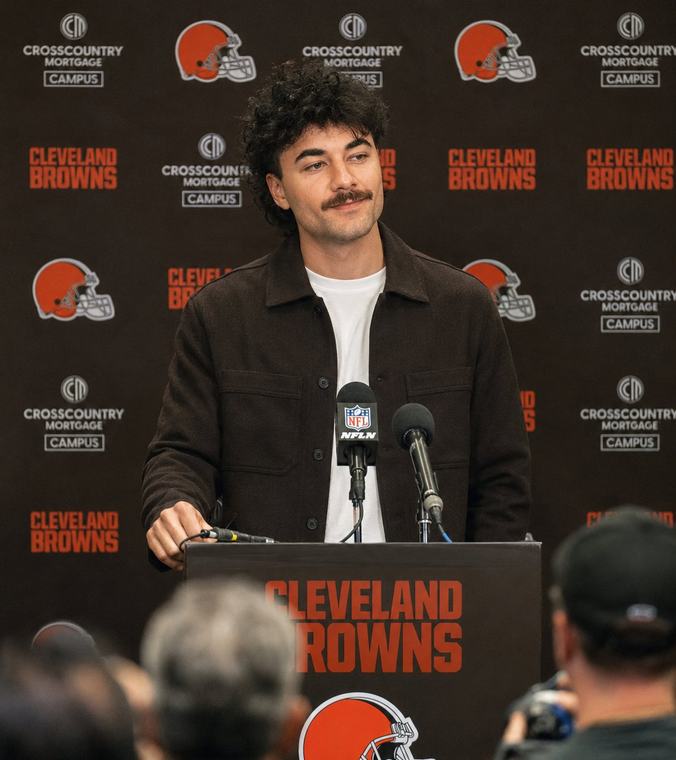
He was asked, in the fourth question, how a club that had been told for eight months it would have to eat salary in November had instead been paid two first-round picks in August. He did not answer it.
“Tim Vukovich made every call on this one, including the ones where somebody hung up on him,” Mansour said. “Renee Ocampo built the contract sheets and she built four versions of them because I kept moving what I was asking for, and the fourth one is what we used. Brandon Lynch had Darnell Savage playing outside corner in the second week of July, which is six weeks before any of this. You should ask Tim. He’s also the guy who put my name on a list in January, so his judgment has been suspect for a while.”
Two reporters laughed. He waited for it and then answered the next question, which was about Grant Delpit in the slot.
I asked him twice, once in the room and once in a hallway afterward, whether Pittsburgh had been the target from the start. Both times he answered a slightly different question, and did it warmly, and did not appear to think he was getting away with anything. On the third try I asked whether it bothered him to trade inside the division. “That’s fair to ask and I don’t want to answer it,” he said. “I’d rather talk about him for a minute, if you’ve got a minute.”
He then talked about Denzel Ward for four minutes and thirty seconds, unprompted, without checking a note.
“In February I had been here about two weeks and Denzel came and found me and asked what I wanted the corners doing on third down. Not to test me. He wanted to know because he had to go do it. He was the first veteran in this place who treated me like the head coach, and he did that at a point where there was no reason for him to and a lot of reasons not to. He asked me to trade him in March and he asked me again in June and he was right both times and I said no anyway. He never took a rep off after either one. If somebody wants to write that I got two first-round picks, fine, but he’s the one who played well enough for a long enough time that somebody was willing to give them up, and he did that here, and he grew up twenty-five minutes from where I’m standing.”
Nordonia
Ward went to Nordonia High School in Macedonia, went to Ohio State, and was drafted fourth overall by the team he grew up watching. He has spent his entire adult life inside a ninety-minute radius. That is a rarer thing in this sport than it used to be, and it is rarer still to do it through the specific eight years Cleveland has had, and Ward stayed pleasant about a great deal that other people did not stay pleasant about.
“My mom’s twenty minutes from Berea,” he said. “I’ve never played anywhere but Ohio. I’m going to have to figure out the drive.” He said he had spoken to Grant Delpit twice by nine o’clock Thursday night, and that the second call was mostly about a house.
Delpit has been here longer than anybody on the roster now. “It’s Pittsburgh, so people are going to want me to say something about that, and I’m not,” he said Friday morning. “Twenty-two started in that room with me and Denzel and now it’s me. He was here in 2021 and 2022 and 2023 and he never asked out then, when it would have been the easy thing. That’s all I want on the record.”
The other way to read this
The straightforward case is that this is very good business, and the people who have spent eight months arguing that a 28-year-old with no professional background could not run a personnel department have to sit with it. He turned a decaying contract on an aging player who had asked out into two first-round picks, from a division rival, without a dollar attached, twelve weeks before the market said it had to happen. Nobody I spoke to on either side disputes that description of it.
And it is also a football team saying out loud that it does not expect to be good in 2027. A club that thought it was going to be competitive next season does not choose to put $24 million of dead money on next season’s cap in exchange for picks that arrive in April 2027 and April 2028. Cleveland traded a starting cornerback for future capital, then chose the accounting treatment that pushes the pain into the first year that capital could plausibly help. People inside that organization are making the first argument and the second one, and to a large extent they are the same people.
The roster underneath it is what it is. Five rookies start on September 13. Three of the five offensive linemen in front of a second-year quarterback making his first Week 1 start are a rookie center, a rookie right tackle and a guard playing out of position. Jeremiah Owusu-Koramoah and Maliek Collins are hurt, the defensive line was the thin spot before either of those things, and Jacksonville opened as a 9.5-point favorite in a game Cleveland is traveling to. I have not found anybody outside northeast Ohio who has this team winning six.
“You can get a great return for a good player and still be bad,” an AFC executive said. “Those are separate questions.” A person in Cleveland, asked the same thing, said the trade would look correct in 2028 and would not help anyone in September, and then asked me not to make that sound like a complaint.
What this changes about how the rest of the league reads Nick Mansour is a question I would rather leave open for a few months than answer this week. Two clubs told me they had adjusted how they will approach Berea on the phone. Two others said nothing had changed and that a seller with a wanted player and no reason to hurry is a position that does not require a great deal of talent to occupy.
Ward’s locker in Berea was cleared on Thursday afternoon while the defense was still on the field. The nameplate above it slides out of a track. By the time the defensive backs came in there was a different name in it, and a folding chair where the equipment staff had set his boxes down.
Jonah Rieger is a senior writer covering the NFL. He reported this story in Cleveland and by telephone over five days. The Pittsburgh Steelers declined to comment. Marcus Lyle declined to comment. Brandon Beane did not respond to a request for comment.